
As I was scrolling the Facebook reels during one of my insomnia fits, I ran across this video from April of a local meteorologist describing to her viewers the difference between a watch and a warning using this graphic.
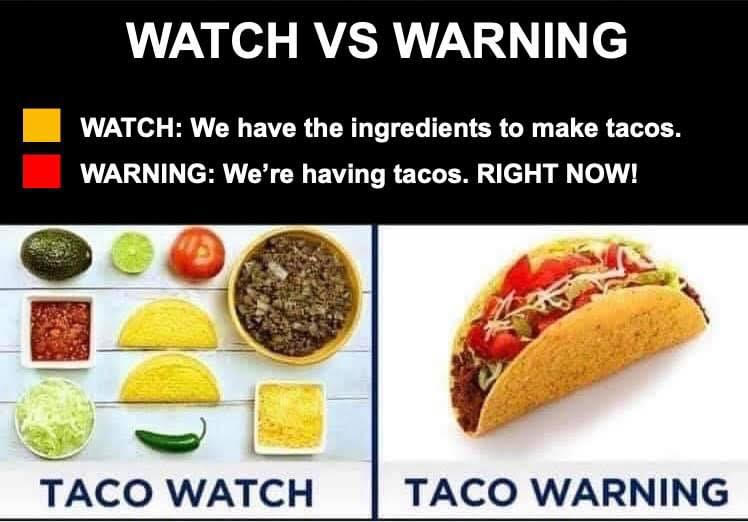
While I do enjoy tacos, and I think this graphic does a great job of explaining the differences between tornado watches and warnings, I don’t think I’m likely to think of tacos when I am stressed out about the impending doom of a giant swirling sky tube. And I’m not alone.
Way back in 2011, Jason Samenow published an article on his Washington Post blog about this very issue.
A study conducted at the University of Oklahoma by Scott Powell and Dan O’Hair tested the weather knowledge of 762 Texans, Oklahomans and Californian. It found 36 percent of respondents did not know the difference between a severe weather watch and severe weather warning. Of the Californians surveyed, 50 percent didn’t know the difference compared to around 30 percent of the more storm prone Oklahomans and Texans. (Emphasis Mine)
Jason Samenow, Washington Post (May 2011)
Let me reiterate. 50 percent of those who are not usually exposed to the differences couldn’t discern between the two terms. Another 30 percent of those who are seasonally exposed still can’t tell the difference.
People are confused and for good reason. First of all, we don’t use the terms, nor are we exposed to the terms half frequently enough for them to become embedded in our lexicon. Just like the terms hazard and risk, we just don’t need them enough in everyday language. Secondly, the words are too similar in their phonetics to be easily discernable when faced with an emergency or high stress event. Even morphologically, the context dictates that the words are the same part of speech thus making that -ing action verb ending meaningless to our brains.
So, now that we are clear of tornado season, I think it’s time to respark an important conversation on the severe confusion between a tornado watch and a tornado warning. Maybe it’s time we change the language away from the jargon of meteorology and into something comprehensible for those of us who aren’t Bill Paxton.

 The Life Argotic
Leave a comment